Saturday, August 2, 2014

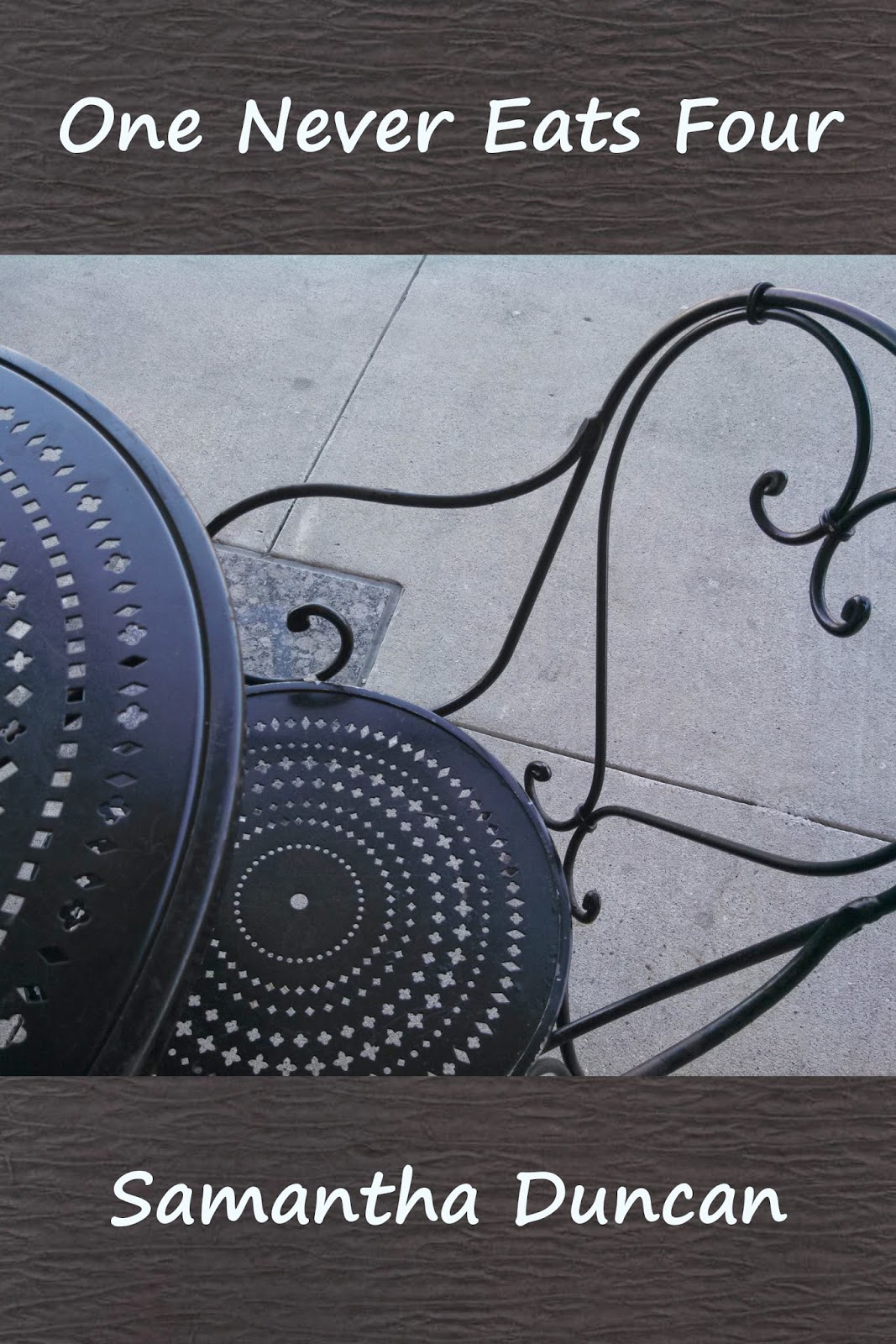
Book Review: Samantha Duncan's One Never Eats Four


http://www.booknook-eljpublications.com/store/p8/One_Never_Eats_Four.htmlIn her short collection of poems One Never Eats Four from ELJ Publications, Samantha Duncan offers a scenic journey through the annals of the poet’s mind. At first, these poems appear loose, the images stacked together as they randomly cascade at you despite the beauty of the language. But as one reads on, the poems quickly tie together, existing not as sole entities, but as a series of interconnected thoughts, thoughts that follow the patterns of the human mind and narrative existence.

In her poem “Shifts,” Duncan works to translate the patterns of life, aging, and existence, and does so by casually and artfully commenting on humanity: “From this life, I don’t want a sonnet./ I can break down boxes that used/ to house kittens for a paycheck, and/ feel full of Vitamin C.” From kittens to vitamins, the reader sees life here and is forced to contemplate the meaning of otherwise menial events. The emptying of a box of kittens has so many implications as does the consumption of Vitamin C, but what do they mean, what do they mean here? Thus, as one advances through the pages, the payoff builds, the images collide, and poetic transcendence is found. We all think about something, say our shoes and somehow end up engrossed in a memory of that time we had a splinter in our forefinger when we were eight and the drop of blood it left on our right sock. Well, these moments, all too human, shape Duncan’s verse.

As mentioned above, much of the beauty is found in the language. It is simple, honed with a scalpel, and thus the images bounce off the page regardless of how connected they initially seem. For example, in “Growth” the introduction of a home inspection, a horrific side effect of selling one’s house where a strange person judges the condition of your home, ends in the discussion of poisoned flowers: “Home inspections permit/ a calendar cadence, a posture/ improvement. She began to/ forget the flowers I poisoned,/ routine was left uneaten.” The thoughts flow, they are seamless, and the reader must work here, must think and connect and imagine. The poetry works on us in only the way poetry can. It is here that Duncan excels, reminding the reader that thought, imagination, and emotion are part of the process.

Earlier, in “This Is Not a Well” Duncan employed the same mastery, this time focusing on the symbolic: “Imaginary water lies where water was, where/ my ribs are pencils that tickle your brain creases.” These ideas are desperate, yet connected just the same in a way that does tickle the brain. Yet Duncan can be overt, as seen in her poem “Fire” where she pens perhaps my favorite lines of the collection, lines that do a better job than a two-thousand work short story I’ve written on the same subject: “The hierarchy of citrus blazing in the front yard,/ hanging on cousin trees, orange, green, and yellow/ past wives, squeezed to the rinds until fluent in/ regeneration. Could feed the village, if there weren’t/ so many individual locked doors. Neighbor houses are/ mute pianos, nearly responsive to seduction.” Duncan comments on society, the castles we live in, the hidden nature of life, yet she does so with image based precision, choosing not slam the reader over the head, but rather to let the reader decipher, consider, and think.

You can purchase the collection here if interested.

Friday, August 1, 2014

From Platles-rich plasma to the Rituals of Successful Humans, collected articles.

The article highlights from the past week. Happy reading.

Platelet-rich plasma treatment is popular for sports injuries, whether it works or not: Washington Post article that explores the interesting but controversial treatment. As a person who has long suffered from an Achilles tendon injury, I have been offered this treatment pro bono and am still considering. The jury is still out, the studies are thin, but the placebo effect is gigantic. For further proof, this Achilles' tendon PRP study shows it may not be worth the discomfort and notes PRP might be more placebo effect than anything else.


Goalkeepers deceive themselves when facing penalty kick:As in the guess--go figure. Interesting read though, worth your time if you love sports.

Seven Ways to Be More Curious: Written by a PH.D., a great article exploring the habits or curious and creative individuals. As one who is curious and aspires to be creative, I found the information helpful;. It does overlap with past reads, but is worth the five minutes.

12 Quiet Rituals of Enormously Successful Humans: As we always look to evolve and change, give this article a quick read. In the name of personal success, productivity, and creativity, these steps are easy to integrate into your life. If not in mass, then in piecemeal or as you see fit. Some are hokey, but worth your time.


Monday, July 14, 2014

Book Review: Tara Shea Burke's Let the Body Beg


https://www.booknook-eljpublications.com/store/p5/Let_the_Body_Beg.html
Typically I am not a poetry guy. Some poems dig into a singular feeling, focusing on a moment or a place, an image or a thought. These works like to linger about dancing on a single spot, cutting a hair over and over for lines and lines. Tara Shea Burke’s chapbook Let the Body Beg, from ELJ Publications, hits you with a fast paced selection of verse that moves you between spheres of understanding and existence. The reader is transported from one end of the emotional spectrum to another. One moment concentrates on a middle school aged girl falling in love only to later expose the reader to revulsion that accompanies such romances. To our delight, emotions are completed, life is cycled through.

Starting with the initial poem in the collection, “Hunger,” Burke digs into the heart of human desire. We hunger for so many things—yes food, but there is so much more, so much more innate and primal hungers as well complex, pensive ones. Yet, man is deeply afflicted, for in many of us there exists the converse: those people who hunger for nothing and struggle to actually exist. Thus Burke sticks the two at the same table, an interaction that allows the reader to not only view the conflict, but to also see both sides to such an issue, one that society avoids at a damaging cost.

Later in “Test,” Burke ponders faith. She questions the body’s needs both physically and spiritually in the guise of a barefoot sleepwalker strolling on ice. Beyond the obvious physical anguish, the reader must confront the narrator’s need and quest for survival on a spiritual level despite the fact that she is lacking in faith. Once again we are treated to both sides of an issue, examining the equation in full.

Throughout the text, Burke furthers the exploration of our position in life, first confronting sex then the gender roles therein. She turns things on their back, proposing one truth before exposing it as another, doing so in a poetic and compelling manner. She contrasts a red lace bra against feminist values, letting the reader see it as a sex symbol to both genders but also as an object that stands out as an aberration during a discussion on feminism due to the gender conflicts it presents.

There is plenty of humor here as well, as found in “The Hungry Girls of America” where Burke explores the lost dreams of America’s girls: “One looks at tattoos on her fingers: FUCK/on one fist, THAT on the other. Unemployed.” Such lines, ones ringing with a combination of honesty and poignancy say so much while lacing the collection with a tint dark humor that keeps the pages turning and the collective message advancing. In the end, the collection seems to center on the dualities it presents, leaving the reader pondering the truths life presents.

Thursday, July 3, 2014

Book Review: Stephen King's Dr. Sleep


Stephen King’s Dr. Sleep picks up many years after the end of the The Shining. After years of emotional torment stemming from his experiences at the Overlook Hotel, Danny Torrance finds himself without a home, without a purpose, and in an alcoholic induced oblivion. In a last gasp effort, he settles down in New Hampshire and looks for redemption. This redemption comes in a similar form to that Father Callahan finds once he joins the Dark Tower series.

Danny is haunted, not only be the mysteries of his childhood, but also by the demons of his not so distant past, one that caught up with him after one to many one night stands and awkward mornings. Thus we track Danny’s odyssey through redemption, his adherence to AA mantra, and his mysterious role as Dr. Sleep at a Hospice, where, for he makes use of his shining in order to allow souls to pass from one world to the next. In a way, this section of the narrative passes as one would expect. This is not say it is cliché or uninteresting, but the series of events leads us to find Danny as we would want to: a respectable citizen living in a respectable, albeit supernatural, manner.

Built into this tale comes the True Knot, a group of spirit vampires who derive their immortality by sucking away the souls of children who shine. They have tremendous psychic ability themselves, ranging from the power of suggestion to sleep induction to shining location. The transverse the United States looking for souls to feed on while living off of their tremendous wealth. Thus they are the evil, killing kids and filling papers and police departments with missing persons data. Yet, they are wasting away, the souls of the shining, or steam, have waned over the years, and so have their backup stores.

It is pitted against this need for food where Danny, now Dan, is given the opportunity to stand as a protector, to fight back and seek redemption for his ills while overcoming the events of his childhood. He can either revert to the visage that was his father or grow into a new, more powerful man, one capable of eliminating an evil and saving a little girl, one who shines far brighter than even he, Abra Stone. King, as always, writes a strong narrative, and the narrative pulls you through.

Abra is a believable teen, but her emotions are not always as strong as one would expect—she is in fact too grounded at times. Andi, who is giving an entire early chapter to be both introduced and then inducted to the True Knot, is underutilized. Here is a woman who can put you to sleep with a single whisper and after her introduction, she becomes a flat character with a casual mention. One would have thought she would play a larger, more crucial role in the narrative.   Similarly, the True Knot faces a crisis, yet how long has such an event been in coming and why? The problem comes off as almost manufactured, almost out of nowhere, and perhaps too simple for a group of such power. As the narrative progresses, Dan stands tall, as one would expect, and he faces his demons, giving a thrilling, page turning tale that King fans should enjoy.