This piece of fiction
was originally published in The Writers Post Journal in December 2005.
Sadly, the publication no longer exists (Yep, the published me more than
once).
One-Eyed Love
By Steven Stam

Ritual dictates
that Tom Quigley read the obituaries for breakfast.
He knows who jumped off the cliff of life by
nine, plans which funeral to crash by ten.
Tom doesn’t know if Jesus approves of his habits—he thinks Jesus
does—nor does Tom know if he will ever again find a paying job.
He has only one leg, one eye, half a head of
hair.
“I have an empty
feeling in my gut,” Sharon says. Tom
turns a page, ignores. “Would you like
some toast?” she continues, “Coffee?
Anything? Damn it Tom, I’m
talking to you.”
Averting his eye
from the paper, Tom peeks at his former wife – her face is angular and sharp,
chin long and protracted, her hair a red mess of hay. He wants to take a nail file to her chin,
file it down the same way a prisoner desires to slice through steel bars. There is so much about Sharon he wants to
change.
“Paper,” he
says. He glides fat, stubby fingers over
his coarse beard, up to the empty socket he once called a left eye, and then
down to his lizard of a tongue. He gives
the digits a thin lick and turns another page.
Never does he make full eye contact with the woman he called wife for
eighteen years, the angry woman who stares past him, seemingly transfixed by
the square of white light streaming through the kitchen’s only window. He thinks she wants to escape through the
beam, to zoom away into the sun.
“No shit,
Tom. All I want from you is a straight
answer. For Christ’s sake, what are
you reading?”
“Like I said, the
paper. Don’t use Christ.”
Sharon stands up
from the table, her chair flaps back in a chalkboard screech, teeters on the
edge of tipping, but settles back to the floor.
“Go to hell,” she
says and then she stalks out of the room, her highlighter pink robe trailing
behind.
“No. I
won’t,” he replies in a shy whisper, “No, I won’t.”
Tom is not enraged at her; he is content—content to
read the paper, content to sleep on the Tom thinks
celibacy might be his easiest restraint.
How many women want a forty-five year old, unemployed, half-blind,
half-bald, gimp of a man? Sharon, he
thinks rhetorically, she yearns for me.
couch, content to be divorced. He is
even content to be celibate.
At times Sharon begs him to inhabit the bed that was
once theirs, to spread his warmth, his clumsy seed. He says no to that too, ignores the sagging
putty of her unkept body. Before the
accident, desire would’ve driven him to plunge into her sour offerings. Things changed. Tom found Jesus and Sharon grew pungent,
destructive. She never brought another
man home and has always been resentful that Tom did.
Ask Tom when he found Jesus and he won’t be able to
answer. Ask him how and he will weave a short, bland tale that might warm your
heart. He recounts the tale almost every
day, at every funeral, to some distraught man or woman, someone not wanting to
hug or feel or care.
Alone in the kitchen, Tom remembers the speech he
gave just the day before. “I found the
Lord,” he said, “My journey was hard. I
lost my job, my wife, my leg, my eye, part of my scalp. I was walking during my lunch break. Sun was bright, a beacon for all, yet I
ignored it. I ignored everything, the
cool breeze, the joy of living, and my lack of piety. I can’t say whether what happened was an
accident or the hand of a not-so-fellow pedestrian or the will of Jesus
himself. Either way, I was thrust into
traffic and forced to pay heed. When I
woke eight days later, I reentered the world not only as a man who couldn’t
feed himself, but also as one spiritually ready for a second chance. It took eight comatose days for me to find
life, two days longer than for God to create the world, to create all but
sin. Sin came on its own.
“You would think I
would’ve spurned the creator in that condition, but when I woke all I wanted to
do was live and honor my chance for redemption.
Instead of angry and questioning distrust, I willed myself to survive if
only to spread God’s word. I know it’s
hard to stomach that a man can wake up crippled and embrace God. All I can say, all I can exclaim, is that the
difficulty was I hadn’t embraced him in the first place.”
The man Tom had
spoken to nodded, yanked at his maroon tie, and adjusted his stained black
coat. Absently the man scuffed at one of
the stains, a criminal spot of white fluff, in an effort to clean and shape his
appearance.
“What next?” the
man asked. “What did you do?” His face was an old cloth—worn and faded and
torn.
“I confronted what
happened,” Tom said.
“And?”
“I was
shocked.”
“Why?” the man had
said.
“Life. I still had life.” From there Tom went into an account full of
opaque details about the accident: how a blue pickup truck swerved to avoid his
falling, twisting body, and the truck twisted itself, flipped and rolled about;
how three other vehicles became intertwined in the bitter dance of screeching
brakes and snapping, paralyzing metal; how of the seven people involved, the
only one who lived was the most vulnerable one, the pushed pedestrian Tom. All were secondhand details, details received
through the accounts of others and passed on via Sharon. When the speech ended the man stood and
examined Tom in a reflective manner while Tom waited for the payoff, for the
thankful completion of his catharsis.
But the man turned to leave and return to the funeral and the grief
therein, pausing only to pat Tom’s shoulder.
“My wife … my
wife’s doesn’t,” the man had said. His
eyes pruned.
“Doesn’t what?”
“Have life. She’s the one there, in the coffin.” With those bitter words the man walked
away.
Tom’s face
tightened in shock, and he stayed that way, remaining mute and somber when
Sharon picked him up and drove him home.
Space was the silence that separated them and what stabbed at Tom the
most was knowing Sharon understood what had happened. At the time, Tom was beginning to feel Sharon
was aware of everything.
Tom lives in a
clouded world of pain. Often, under the
hand of night, his back aching from sleeping on his aged, cottage cheese couch,
Tom senses cars bearing down on him, the jarring, darkening force of impact, of
death, and he pops out of his dreams screaming for God, fear sweating through
his skin. Sharon listens, runs to his
side out of residual compulsion, and even wipes his brow. Such actions only inflate her anger.
Thinking about his
prospects for the day, Tom puts the morning paper on the table. He flips to the
front-page, letting the obituaries ruminate in his mind. A picture of a little girl, age nine, sits
squarely in the middle. He examines the
photo as one would a precious stone.
It’s hard for him to discern concrete details from the pixilated
photograph, but the girl has dirty blond hair done up in pigtails and a navy
blue dress. From the caption he finds
out her name is Jean, and Jean is smiling a hole-marred smile; she is
alluring—oddly so—in need of permanent teeth, and in the hospital. “Girl jumps off house to fly with angels,”
the headline reads. Apparently Sunday
School talk of angels and wings and love and heaven and God and her mother’s
love for the deity combined with her father’s propensity for constant prayer
had created a stilted equation. Heaven
and bliss appealed to Jean so much that she went in search. Foolish, Tom thinks and wants to go see her
if only to share himself.

Children irk him
in the right way. A child might have
saved Tom’s marriage. Always wanting
one, never having one, Sharon and Tom Quigley had little to bind them together
outside of blame. Blame trickled in at
first, meandering down Sharon’s leaky faucet of emotions, eventually
manifesting as a pool on Tom.
They were tested
for fertility, tried everything they could, but trying and testing, testing and
trying, only tested and tried their union.
Money prevented the use of the fancy drugs, the ones that allow women
not only to have a single child but a litter worthy of a cat. In the end it was Tom. Tom’s well of posterity was first dry and
rotten and then eventually marred by the accident.
Pulling a pen from
his robe pocket, Tom returns to the obituaries, flips directly to the one he
has in mind, and circles the paragraph in black ink. He recites the words to himself, “Burbank – Robert William (Bill), aged 68 years, of Lawrence,
passed away by car accident March 11 in Lethbridge. Beloved husband of Emily, loving father of
Mark and Ryan. Born in Cleveland, he
resided in Lawrence, Georgia for the duration of his adult life and was a
mechanic by trade. Funeral Services will be held at Leyden’s Funeral Home on
Wednesday, March 16 at 1:00 p.m. with interment at Oakwood Cemetery.”
“Stop reading that shit in my house,” Sharon says, “I’m
tired of it. That crap is worthless to
you. Didn’t you learn a thing yesterday?
Why don’t you let people die in peace?”
Standing in the doorless doorway that divides the kitchen
from the living room, Sharon’s robe dangles open revealing chunks of fatty
flesh. Tom stares at her, at the
discolored skin bulbously protruding out, the single royal blue vein, and
thinks how beautiful she once was, how he couldn’t keep his hands off her and
lusted for her, lusted all over her. Now
Sharon conjures up the image of a red haired sea wench; her fingers digging, grabbing,
and prying at him.
“They’re already dead,” he says, “stop cursing.”
“But their families aren’t and it is their families that
you torment. And why shouldn’t I
curse? Why? Why should I stop? What are you going to do about it? I think you should think for a minute, think
about what happened to you yesterday, the day before, the one before that. They don’t want to hear you, not anymore, not
ever. These people see you as a monster,
a pathetic leech of a monster.” Sharon
steps into the kitchen. Her voice rings
in Tom’s ears.
Seeing her exposed makes Tom’s mouth feel as if it has been
swabbed dry with cotton. He hasn’t seen
her naked body in two years, hasn’t seen nudity other than his own in just as
long. The shock registers different than
he would expect; the internal urge to grab her, dominate her, resign to her
wishes, rises up. He sits there at the
table, a statue staring at his ex-wife’s pubic region.
“And what do you think you are looking at?” she says,
“Aren’t you too pure to gaze upon my flesh?
You’ve rejected me every minute since the accident. My touch, my love hasn’t been enough. I know I’m not the young, toned woman you
married, but I am the one you did marry.”
“The one … the one I divorced.”
“Screw you. Screw
fucking you. I’m also the one who didn’t
take your house, who couldn’t have your children.”
“No. Don’t say
that. The children – Please, please
respect me, my wishes.”
“Respect you?
Respect me. I stood by you in the
hospital. Maybe I didn’t hold your hand
or cry on your face like a housemaid, but I was there. I looked at you, the new you, the crippled
you, and beneath the gore I saw my husband.
I gave you eighteen years.
Eighteen fucking years. And then
you became righteous, decided I was the mold on your life, and threw me in the
fucking trash.”
“Righteous? That’s
not the case. I just wanted to live, to
start living. I wanted to help people,”
he says.
“So you divorced me, left my bed, our bond? Way to go Tom. Way to fucking go. First you cracked the sacrament of marriage
to hell and then you decided to stay, to live with a woman out of wedlock. I know you had no other place to go, but
hell, a holy man such as yourself wouldn’t have stayed. A holy man wouldn’t have expected his ex-wife
to help him bathe, to drive him places, to take him to a funeral a day after he
divorced her. What do you think Jesus
thinks? Bet he says you’re fucking
grand.”
“Don’t talk about him that way … calm down. We’ll talk about this later. I-I have a funeral to go to. Come on, get dressed.”
“You have no right to order me around. And a funeral? You can’t be serious? You’re not changing the subject on me, not
this time. You’re going to hear me out,
act the part. You’re my husband
Tom. The law may say different, but
we’re still connected in that church of yours, there has been no annulment, and
the time has come to right the ship.”
Sharon stomps across the kitchen to his side, grabs the fringes of her
robe, and drops it to the floor. She
stands nude above him, a sagging statue of contempt, and she spreads her arms
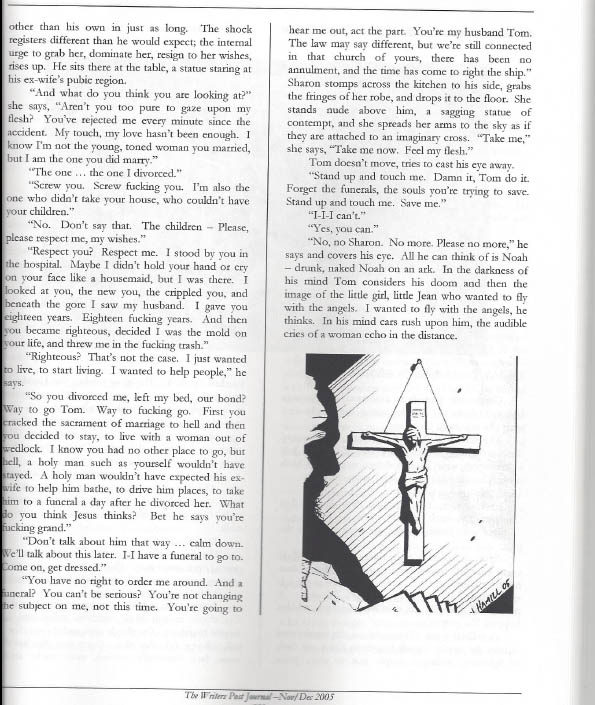
to the sky as if they are attached to an imaginary cross. “Take me,” she says, “Take me now. Feel my flesh.”
Tom doesn’t move, tries to cast his eye away.
“Stand up and touch me.
Damn it, Tom do it. Forget the
funerals, the souls you’re trying to save.
Stand up and touch me. Save
me.”
“I-I-I can’t.”
“Yes, you can.”
“No, no Sharon. No
more. Please no more,” he says and covers his eye. All he can think of is Noah – drunk, naked
Noah on an ark. In the darkness of his
mind Tom considers his doom and then the image of the little girl, little Jean
who wanted to fly with the angels. I
wanted to fly with the angels, he thinks.
In his mind cars rush upon him, the audible cries of a woman echo in the
distance.